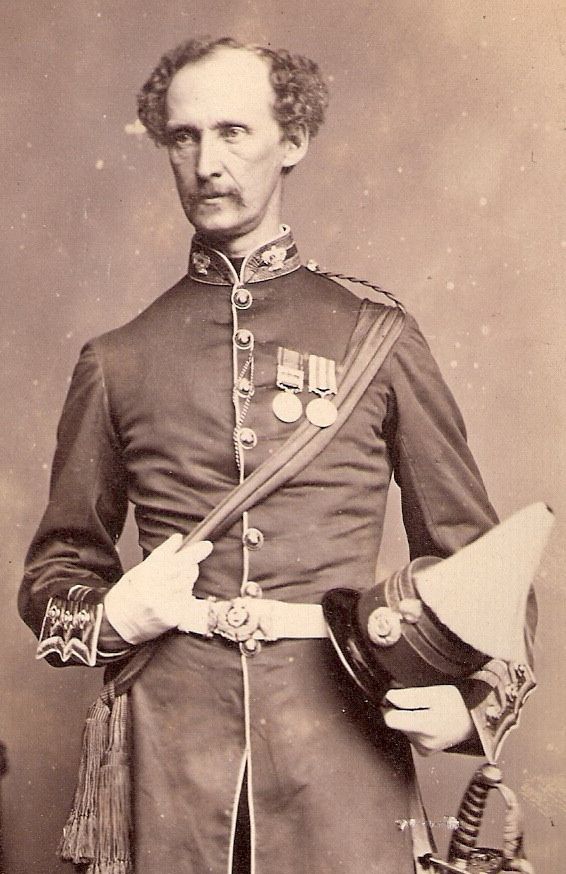
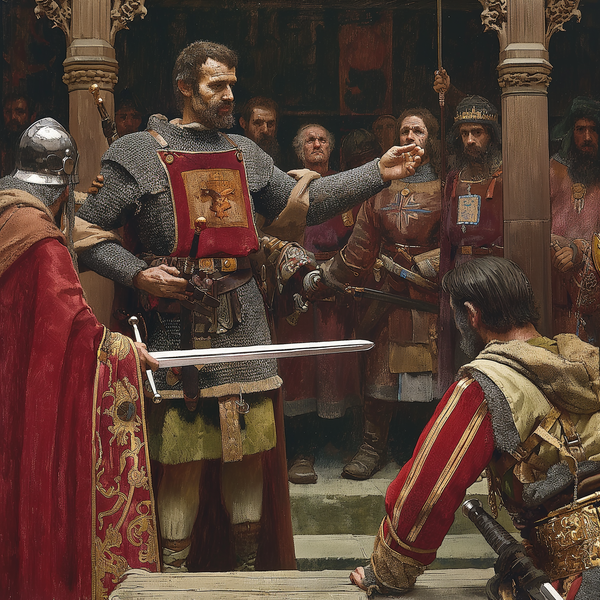
Odo (Otto, Eudes) de Fourneaux [circa 1086]
The oldest known written evidence of Furneaux in Britain

![Odo (Otto, Eudes) de Fourneaux [circa 1086]](https://storage.ghost.io/c/a4/db/a4db4510-aa49-46b3-b154-4b5ff7862758/content/images/size/w1200/2026/05/reference-to-odo-in-domesday.png)
One of the first recorded person in our Family tree is one Odo (or Otto, or Eudes) de Fourneaux. This blog examines what we know if him after 1066. A subsequent blog will address his previous location before this, and his role in society. According to the Oxford Dictionary of Family Names, the Furneaux family in Devon descends from him.
There is some difficulty in identifying exactly who was who, where and when, as the information is nearly 1,000 years old. However, I have tried to cite multiple sources, and resorted to experts when original sources are lacking.
His first name
As discussed in my blog on the Furneaux Family Name there is a considerable variety in the way Medieval names were spelt, however were understood as belonging to the same person. In case we think this rather arbitrary, even today people go by different first names, with diminutives (Maggie, Midge, or Peggy for Margaret), short forms of their full names (Alex for Alexander), and that many people often use a middle name instead of a first name,. Thus, there can be considerable variety of names even though the same person is intended.
In the case of Odo / Otto / Eudes this seems to be driven more by language than anything else, with the same name being spelt differently depending on language.
- Odo [a palindrome] - Ancient Germanic Old Saxon also common in France
- Otto - [a palindrome] later German, Swedish, Norwegian, Danish, Dutch, English, Finnish
- Eudes - Medieval French for Otto
Odo, Otto and Eudes are all variants of Old Germanic 'aud' meaning wealth, fortune, or riches. Thus Odo de Fourneaux would literally mean 'wealth' (Odo) 'from' (de) 'furnaces' (Fourneaux), although Fourneaux is actually a place name. I will use Odo here, as this is the form used in the main documents we are referring to.
Just for interest, the Pope Urban II of 1088, was also called Odo, Otto and Eudes, indicating the name variant was not uncommon.
I have spend some time digging into the evidence from multiple sources which is presented here.
Summary of the Evidence
There are a number of sources close to the Norman Conquest which support the existence of Odo de Fourneaux.
The Exon Domesday - The Exon Domesday is the pre-cursor to the full Domesday, and is a far more detailed version, covering a number of counties in South West England.
According to Dr Robert Bearman2 the Exon Domesday names one "Odo Defornelt" (which other sources note as being acknowledged as a variant spelling of Fourneaux).
While some authors (such as The Exon Domesday is currently being digitised, so I hope to be able to update this section once that has occurred.
The Domesday Book is an amazing document as it was completed in 1085-86 and summarises the land of where his name appears, and with it the taxes and military obligations, at the time of Wiliam's reign.
There are no Furneaux / de Fourneaux listed in the Devon region, however there is an Odo listed as holding the lands of Cudworth, Somerset. The excerpt from the Domesday Book of where Odo appears, is provided below. Dr Robert Bearman2 contends that the Odo in the Domesday book is the same person as the Odo de Furnell listed in the Exon Domesday.
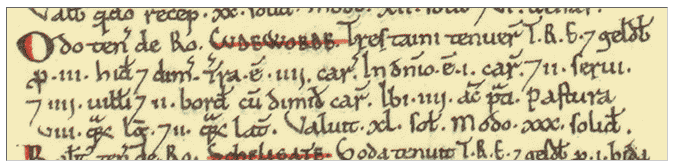
1A descendent Alan de Furneaux gave the local Cudworth church to Wells Cathedral in 1186, which places the family in charge of the area just afterwards.
The Falaise Roll - is the work of Crispin, who undertook significant research in France. Unfortunately, this source is also contested by some authors.
The Falaise Roll lists Eudes de Fourneaux as a companion of William the Conqueror at the Battle of Hastings, and as holding Cudworth 'in capite'. [Please note that he does not appear on the acknowledged list of Williams Companions however].
In capite means from the King. This does not seem to be supported directly by the Domesday books, as in both the main Domesday and the Exon Domesday, Odo holds the lands of Roger Arondel. Likewise, other authors argue that the Eudes de Fourneaux in the Falaise Roll is the same as Odo de Furnell who held Cudworth.
The Battle Abbey Roll is likewise meant to be a list of the companions of William the Conqueror. Difficulties with this is that there are many versions of the Battle Abbey Roll, and none of these concurs (list the same names) as the other.
Commentary on the Battle Abbey Roll list Odo de Furnell as being with William and also holding Cudworth.
Conclusion
There is evidence that there was an Odo de Fourneaux who travelled to England around the time of William the Conqueror. He was granted land from the King. Many experts conclude that the Odo of the Domesday Book is the same as the Odo de Furnelt in the Exon Domesday. The family certainly had land dealings in the area shortly after that, which would lend support to that claim. Many of these sources also claim that Odo arrived with William in 1066, however this is contested.
1.Palmer J, Slater G. Cudworth. Open Domesday. http://opendomesday.org/place/ST3710/cudworth/. Accessed April 2, 2018.2.Bearman R. Baldwin de Redvers: . In: Harper-Bill C, ed. Proceedings of the Battle Conference. Vol 28. Anglo-Saxon Studies. Woodbridge: Boydell Press, ; 1995:19-46.